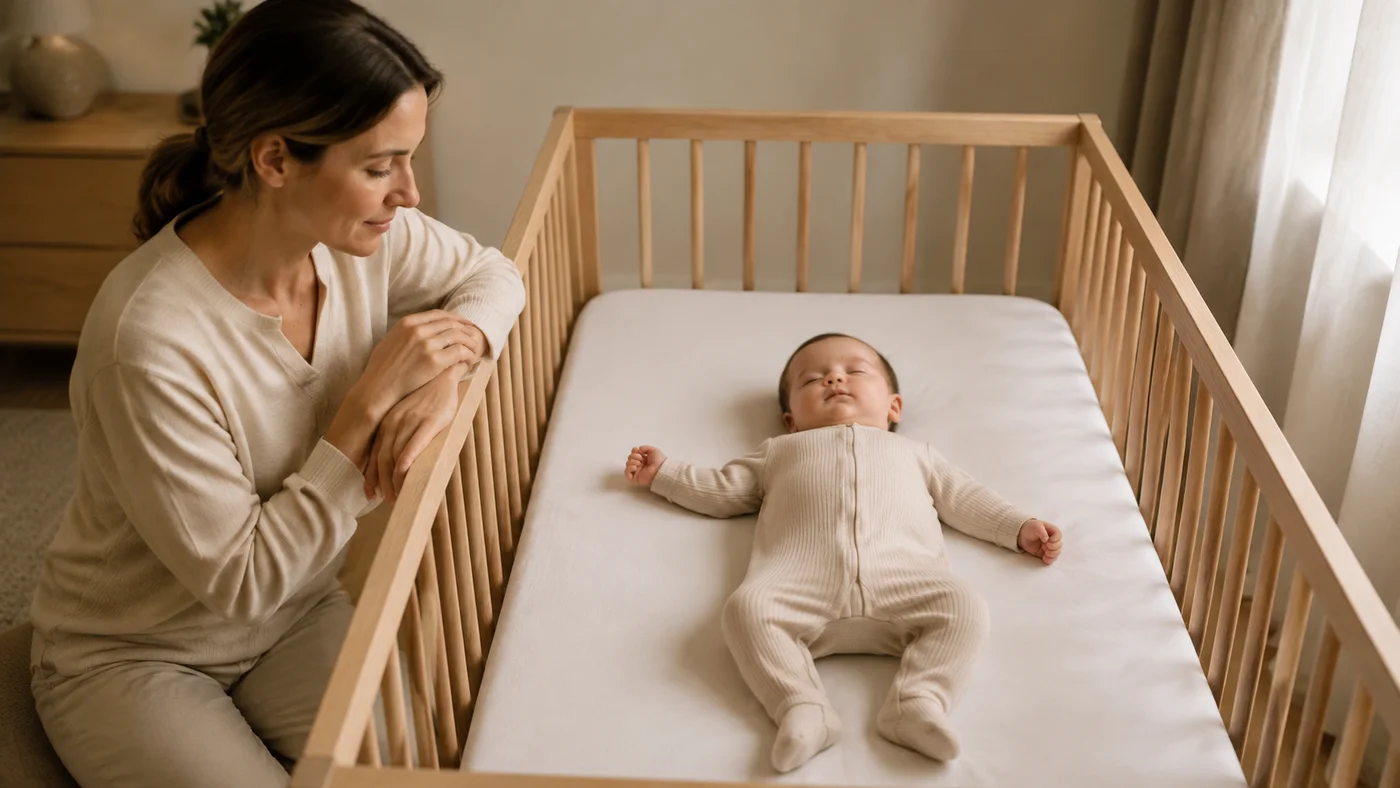
Predictions and logs
A prediction is a starting point, not a required time
Understand the difference between an observed event and an estimate through a clearly fictional sequence where the real nap end changes the next anchor.
What you observed is not what was estimated
A wake-up you saw on the clock, a nap start you witnessed, and an observed end are events. A next moment shown by a calculation is an estimate: it can guide preparation, but it does not replace looking at the baby and the context.
If you found the baby asleep, do not turn that moment into an exact fact. Use an approximate note and keep the uncertainty visible; a precise line in the diary cannot make a memory more reliable.
How to read the next estimate
Separate facts and predictions
Mark a seen wake-up and nap end as events; keep the next time in the estimate category.
Follow a fictional sequence
Use example times to understand the logic, never as an ideal routine to copy.
Update the anchor when the day changes
Log the real sleep and rerun the simulation or organize the day from the observed event.
A fictional sequence using the real nap end
Imagine, only as an example, a 07:00 wake-up and an estimate near 09:30. The family starts winding down, but the baby falls asleep at 09:42 and wakes at 10:18. The 10:18 time is the observed end; it is not a target or proof that the day should follow a table.
If the same nap ends at 09:55 on another day, that new observation changes the anchor used to organize the next moment in the example. The public simulator does not learn from a personal history: it works with the information you enter for that simulation.

When the day changes, change the question
Instead of asking whether the prediction was right, ask what changed: the real sleep end, travel, hunger, a different caregiver, or an opportunity that did not happen. This turns the calculation into support for the next practical decision.
Log the new event before comparing times. That way you do not confuse an old prediction with what actually happened, and you can explain the sequence to another family member.
Limits still matter
A prediction does not diagnose, decide feeding, comfort, or safety, or guarantee that a baby will sleep at a certain time. The result also depends on the quality and accuracy of the information entered.
Use the reference flexibly and seek pediatric guidance for health concerns. A numerical example explains a process; it is not a medical schedule for a specific child.
A fictional sequence of estimates and observations
- 07:00Observed wake-up.
- 09:30Estimate used to prepare the room.
- 09:42Observed nap start.
- 10:18Observed nap end; new anchor in the example.
Frequently asked questions
- Is a prediction a time I must follow?
- No. It is a reference for organizing the next moment. Observe the baby and context, then record what really happened.
- Does the public simulator learn from previous days?
- No. The public simulator uses the information you enter for that simulation; it does not build a personal history or provide a medical schedule.
- Why does the real nap end change the next calculation?
- In the example, the observed end is a new anchor for organizing the sequence. It does not guarantee a result or remove the need to observe the child.
Final considerations
This article uses fictional times to explain a reference. Predictions do not diagnose, replace pediatric guidance, or define a required schedule.
References
- Sonequinha, public simulatorPublic tool used as a simulation reference, without a personal history.
- NHSPublic reference on infant sleep variation and environment.